Why Quality Assurance Still Matters in the AI Era: The Critical Role of Human Testing in Intelligent Software
While AI accelerates software development through automation and intelligent decision-making, Quality Assurance remains critical for ensuring accuracy, security, compliance, and user trust. Explore the evolving role of QA in the age of Artificial Intelligence.
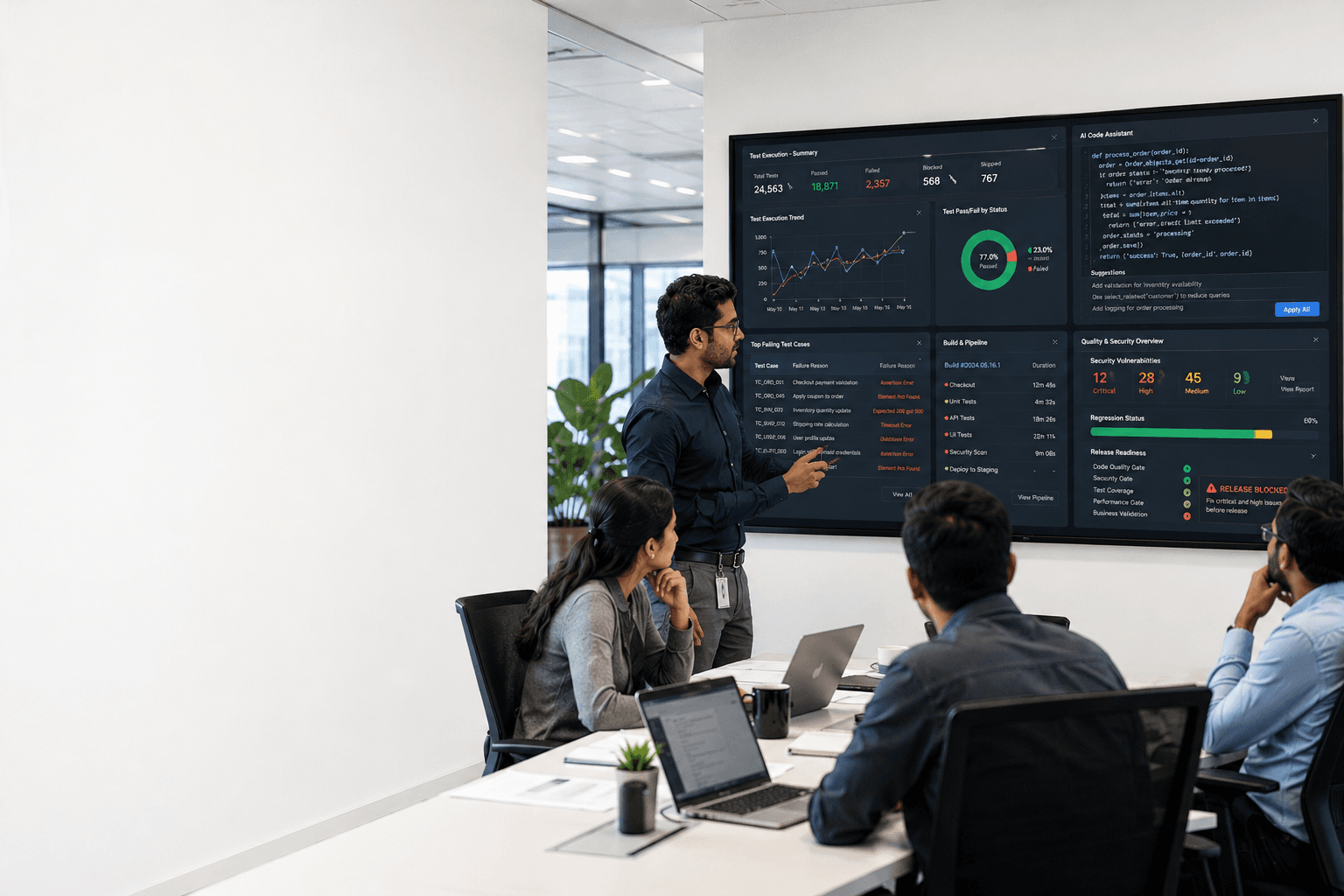
Why Quality Assurance Still Matters in the AI Era: The Critical Role of Human Testing in Intelligent Software
Artificial Intelligence is transforming software development at an unprecedented pace. From AI-powered coding assistants and automated test generation tools to intelligent deployment pipelines, organizations are leveraging AI to build software faster and more efficiently than ever before.
As AI continues to automate coding, testing, and development processes, a common question has emerged across the technology landscape:
If AI can generate code and automate testing, do we still need Quality Assurance?
The answer is a resounding yes.
While AI has significantly accelerated software development, it has not eliminated the need for Quality Assurance. Instead, it has introduced entirely new challenges that make QA more critical than ever before.
Today's software teams are not only testing applications—they are increasingly responsible for testing the AI systems that power them.
The Rise of AI in Software Development
Artificial Intelligence has become an integral part of modern software engineering.
Development teams now use AI tools to:
- Generate code snippets and complete functions
- Create automated test cases
- Detect bugs and vulnerabilities
- Analyze large datasets
- Improve development productivity
- Accelerate deployment cycles
These capabilities enable organizations to release products faster, reduce repetitive work, and improve operational efficiency.
However, speed alone does not guarantee quality.
AI systems learn from data and generate outputs based on probabilities rather than fixed rules. This creates a new layer of complexity that traditional software testing approaches were not designed to handle.
Traditional Software Is Predictable. AI Is Not.
Conventional software follows predefined instructions. Given the same input, the application should consistently produce the same output.
AI-powered systems behave differently.
Large Language Models (LLMs), recommendation engines, intelligent assistants, and autonomous systems rely on patterns learned from massive datasets.
As a result, they may produce different outputs for similar inputs.
This unpredictability creates unique challenges for Quality Assurance teams.
Testing AI is no longer limited to verifying whether a feature works correctly. It also involves validating reliability, consistency, fairness, security, and trustworthiness.
AI Can Be Wrong With Complete Confidence
One of the most significant challenges associated with AI systems is hallucination.
AI models can generate responses that sound accurate and convincing while being entirely incorrect.
Examples include:
- Incorrect customer support responses
- Misleading financial recommendations
- Inaccurate legal information
- Fabricated facts presented as truth
- Faulty business insights
Unlike traditional software defects, these errors are often difficult to identify because the output appears credible.
Quality Assurance teams play a crucial role in identifying and preventing such risks before they reach end users.
AI-Generated Code Still Requires Thorough Testing
Many organizations now use AI-powered coding assistants to accelerate software development.
While AI-generated code can significantly improve productivity, it is not immune to errors.
AI-generated code may introduce:
- Security vulnerabilities
- Incorrect business logic
- Performance bottlenecks
- Compliance issues
- Scalability concerns
- Unhandled edge cases
Just because code compiles successfully does not mean it is production-ready.
Quality Assurance ensures that software not only functions correctly but also meets performance, security, usability, and business requirements.
Security Testing Is More Important Than Ever
As AI adoption increases, so do security risks.
Traditional security testing focuses on vulnerabilities such as:
- SQL Injection
- Cross-Site Scripting (XSS)
- Broken Authentication
- Authorization Issues
- API Security Weaknesses
AI-powered applications introduce entirely new attack vectors.
Modern QA teams must now evaluate:
- Prompt Injection Attacks
- Data Leakage Risks
- AI Jailbreak Attempts
- Model Manipulation
- Adversarial Inputs
- Unauthorized Information Exposure
Without rigorous testing, AI systems can become vulnerable to exploitation and misuse.
Bias and Fairness Cannot Be Ignored
AI systems learn from historical data.
If the underlying data contains bias, the resulting model may produce unfair or discriminatory outcomes.
This is particularly important in industries such as:
- Healthcare
- Banking and Finance
- Recruitment
- Insurance
- Education
Quality Assurance professionals are increasingly responsible for identifying bias, validating fairness, and ensuring ethical AI behavior.
These responsibilities extend beyond traditional software testing and require a broader understanding of risk and accountability.
Understanding Model Drift
Unlike conventional software, AI systems can become less effective over time.
As user behavior changes and new data patterns emerge, AI models may gradually lose accuracy. This phenomenon is known as model drift.
Without continuous monitoring and validation, organizations may unknowingly rely on outdated or inaccurate predictions.
Quality Assurance teams help detect performance degradation early, ensuring that AI systems continue to deliver reliable results.
The Evolving Role of Quality Assurance
The role of QA is no longer limited to finding bugs before release.
Modern Quality Assurance professionals must answer critical questions such as:
- Can users trust this AI-generated output?
- Is customer data secure?
- Is the model fair and unbiased?
- Does the system comply with regulations?
- Can the AI explain its decisions?
- Will the application perform reliably under unexpected conditions?
As AI becomes more integrated into business operations, QA is evolving into a discipline focused on reliability, trust, and risk management.
Human Testers Remain Essential
Artificial Intelligence excels at automation.
Humans excel at judgment.
AI can automate repetitive testing tasks and generate thousands of test scenarios, but it cannot fully understand customer expectations, business objectives, emotional responses, or ethical implications.
Human testers provide critical thinking, contextual understanding, and exploratory testing capabilities that AI cannot replicate.
This combination of human expertise and AI-powered automation represents the future of software quality.
Who Tests the AI?
This is one of the most important questions facing modern technology organizations.
As businesses increasingly deploy AI assistants, recommendation systems, chatbots, and autonomous agents, someone must ensure these systems operate safely, accurately, and responsibly.
That responsibility belongs to Quality Assurance.
AI does not eliminate testing requirements.
AI creates entirely new testing requirements.
Conclusion
Artificial Intelligence is reshaping software development, enabling organizations to build and deliver applications faster than ever before.
However, AI cannot guarantee quality.
It cannot ensure fairness, security, trustworthiness, compliance, or reliability on its own.
These responsibilities continue to belong to Quality Assurance professionals.
As software becomes increasingly intelligent, the role of QA will become even more valuable.
The future is not about AI replacing Quality Assurance—it is about Quality Assurance ensuring that AI can be trusted.
In the AI era, quality remains a human responsibility.